Manufacturing organisations require more than production planning to achieve operational excellence—they need real-time visibility and control over every activity taking place on the shop floor. Manufacturing Execution Systems (MES) fulfil this role by bridging the gap between enterprise planning and production execution. Acting as the operational intelligence layer of the factory, MES continuously captures, monitors, and analyses production data, enabling manufacturers to optimise workflows, improve product quality, maximise equipment utilisation, and maintain complete traceability throughout the manufacturing process. As manufacturers embrace Industry 4.0 and smart factory initiatives, MES has become a foundational technology for driving connected, data-driven operations.
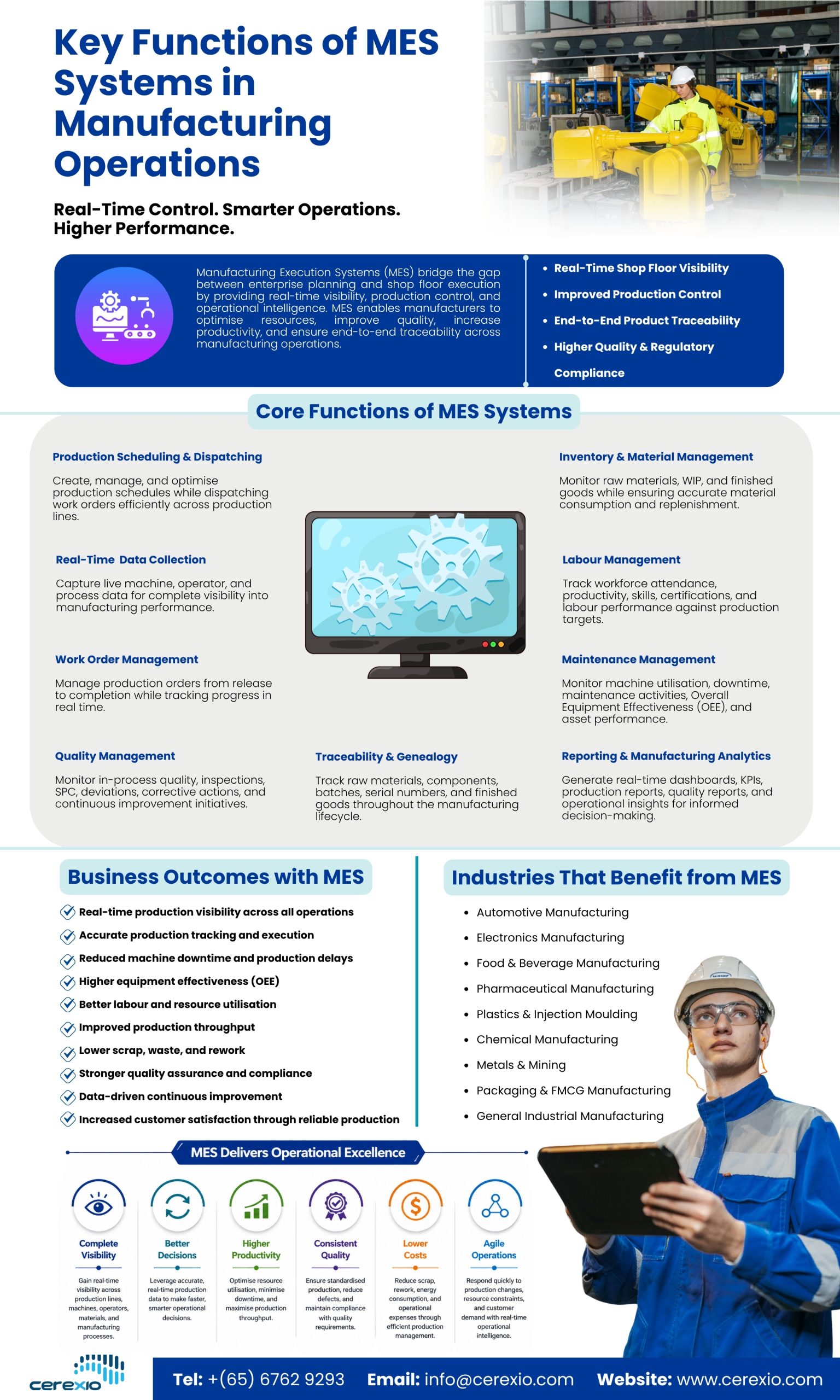
Modern MES platforms encompass a broad range of functions that extend well beyond production scheduling. They support work order management, real-time machine and process monitoring, quality management, inventory and material tracking, labour management, maintenance coordination, manufacturing analytics, and comprehensive product genealogy. These capabilities provide manufacturers with accurate operational insights that improve decision-making, minimise downtime, reduce waste, and ensure compliance with industry and regulatory requirements. By delivering real-time production intelligence, MES empowers organisations to proactively manage operations rather than react to production issues after they occur.
This infographic explores the core functions of Manufacturing Execution Systems and explains how each capability contributes to greater operational efficiency, improved product quality, enhanced traceability, and increased manufacturing performance. It also highlights the industries that benefit most from MES and the measurable business outcomes that intelligent manufacturing execution can deliver.