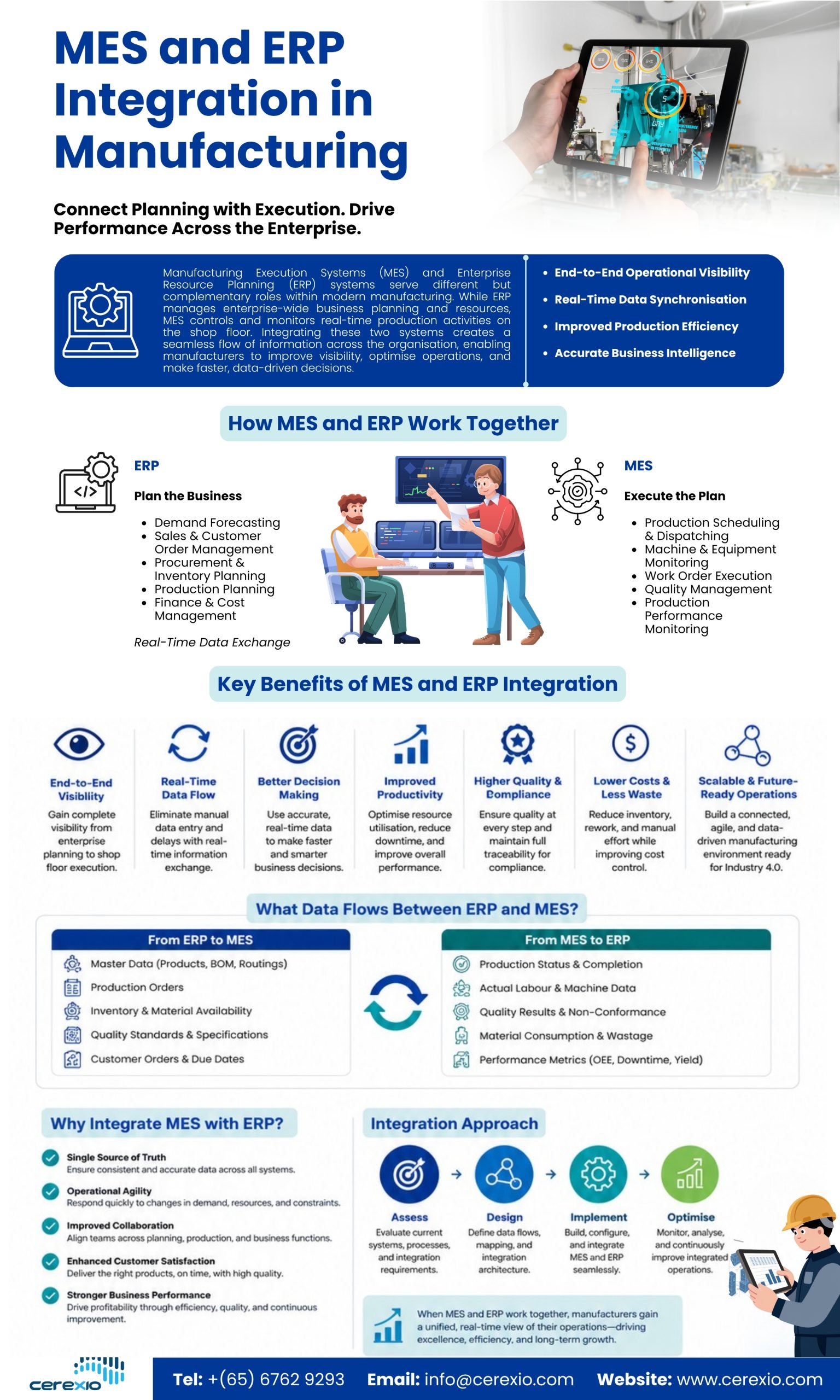
Digital manufacturing depends on the seamless exchange of information between enterprise planning systems and shop floor operations. While Enterprise Resource Planning (ERP) systems coordinate business functions such as finance, procurement, inventory, sales, and production planning, Manufacturing Execution Systems (MES) manage real-time production activities, machine performance, quality control, and operational execution. When these systems operate independently, manufacturers often experience disconnected workflows, delayed information, duplicate data entry, and reduced visibility across the organisation. Integrating MES with ERP eliminates these silos by creating a continuous flow of accurate information between business planning and manufacturing execution.
A fully integrated MES-ERP environment enables production schedules, material availability, customer orders, and quality specifications to flow directly from ERP to the factory floor, while real-time production status, machine data, quality results, inventory consumption, and performance metrics are automatically returned to ERP for enterprise-wide visibility. This two-way data exchange supports faster decision-making, improves production efficiency, strengthens product traceability, and enables manufacturers to respond quickly to changing business demands. It also provides a single source of truth for operational and business performance across the entire organisation.
This infographic illustrates how MES and ERP integration transforms manufacturing operations by connecting planning with execution, improving operational agility, reducing manual processes, and enabling smarter, data-driven manufacturing. It highlights the information exchanged between both systems, the implementation approach, and the measurable business benefits organisations can achieve through an integrated digital manufacturing ecosystem.