
Do you know that 68% of companies still manually enter invoice data? For many finance teams, relying on manual accounts payable processes often leads to inefficiencies and frequent errors. Handling large volumes of paper invoices, chasing approvals through emails or calls, and processing payments manually can slow down operations significantly. These outdated methods also increase the risk of fraud and make audit trails harder to manage.
Accounts payable process automation introduces a streamlined and digital approach to managing payables. By replacing manual tasks with automated workflows, businesses can process invoices faster, improve accuracy, and maintain better control over financial operations.
Automation not only strengthens supplier relationships through timely payments but also reduces processing costs, shortens payment cycles, and enhances overall cash flow performance.
What Is Accounts Payable Automation (AP Automation)?

Accounts payable automation refers to the use of digital technology to streamline and manage repetitive AP tasks such as invoice capture, data entry, coding, approval routing, payment execution, and reconciliation.
Often described as ‘touchless processing,’ this approach minimises or removes the need for manual data handling across the workflow. However, final approvals may still require human confirmation through simple digital actions.
Moreover, modern AP automation software goes beyond task execution by offering real-time dashboards, reporting capabilities, and advanced analytics that provide full visibility into the accounts payable lifecycle.
These tools help finance teams monitor performance, identify bottlenecks, and improve decision-making.
Since all AP data is captured, stored, and organised within a centralised system, businesses benefit from faster searchability, stronger audit trails, improved compliance, and greater overall control of financial operations.
Key Takeaways
- Accounts payable automation reduces manual work, improving speed and accuracy across financial workflows.
- Automating AP processes lowers costs while enhancing cash flow visibility and control.
- Digital workflows minimise errors, strengthen compliance, and reduce fraud risks.
- Scalable AP automation enables businesses to grow without increasing the finance team’s workload.
Challenges With Manual Accounts Payable
Accounts payable (AP) remains a core finance function responsible for managing invoices, vendor payments, and financial obligations. However, traditional manual methods struggle to keep pace with today’s fast-moving, data-driven business environments.
Time-Consuming Manual Data Entry
Manual AP processes depend heavily on staff entering invoice data into systems line by line. This repetitive task becomes increasingly burdensome as invoice volumes grow, consuming valuable time that could be used for strategic financial activities.
The slower processing speed often delays approvals and payments. This may lead to missed deadlines, strained supplier relationships, and additional administrative pressure on already busy finance teams.
Human Error and Financial Discrepancies
Relying on manual input increases the likelihood of mistakes such as incorrect figures, duplicate entries, or missed invoices.
Even small errors can create discrepancies in financial records, requiring additional effort to identify and correct.
Over time, these inconsistencies can impact reporting accuracy, weaken vendor trust, complicate audits, and potentially result in financial losses or compliance risks for the organisation.
Delays and Inefficiencies
Without automation, AP workflows move slowly through multiple touchpoints, from invoice receipt to final payment. Approvals can stall when key personnel are unavailable, and physical documents may be misplaced or delayed.
These inefficiencies can lead to late payments, penalty fees, and missed opportunities for early payment discounts. The latter ultimately affects both operational performance and financial outcomes.
Difficulty in Tracking and Managing Invoices
Paper-based systems and disconnected processes make it difficult to gain clear visibility into invoice status. Finance teams often struggle to determine whether an invoice is pending, approved, or paid, leading to confusion and communication gaps.
As you can see, poor tracking can result in lost documents and time-consuming reconciliations, especially during month-end or year-end closing periods.
While manual AP processes have supported businesses for years, they are increasingly misaligned with modern operational demands. Automation addresses these challenges by improving speed, accuracy, and visibility, enabling finance teams to operate more efficiently and strategically.
How Does Accounts Payable Automation Work?
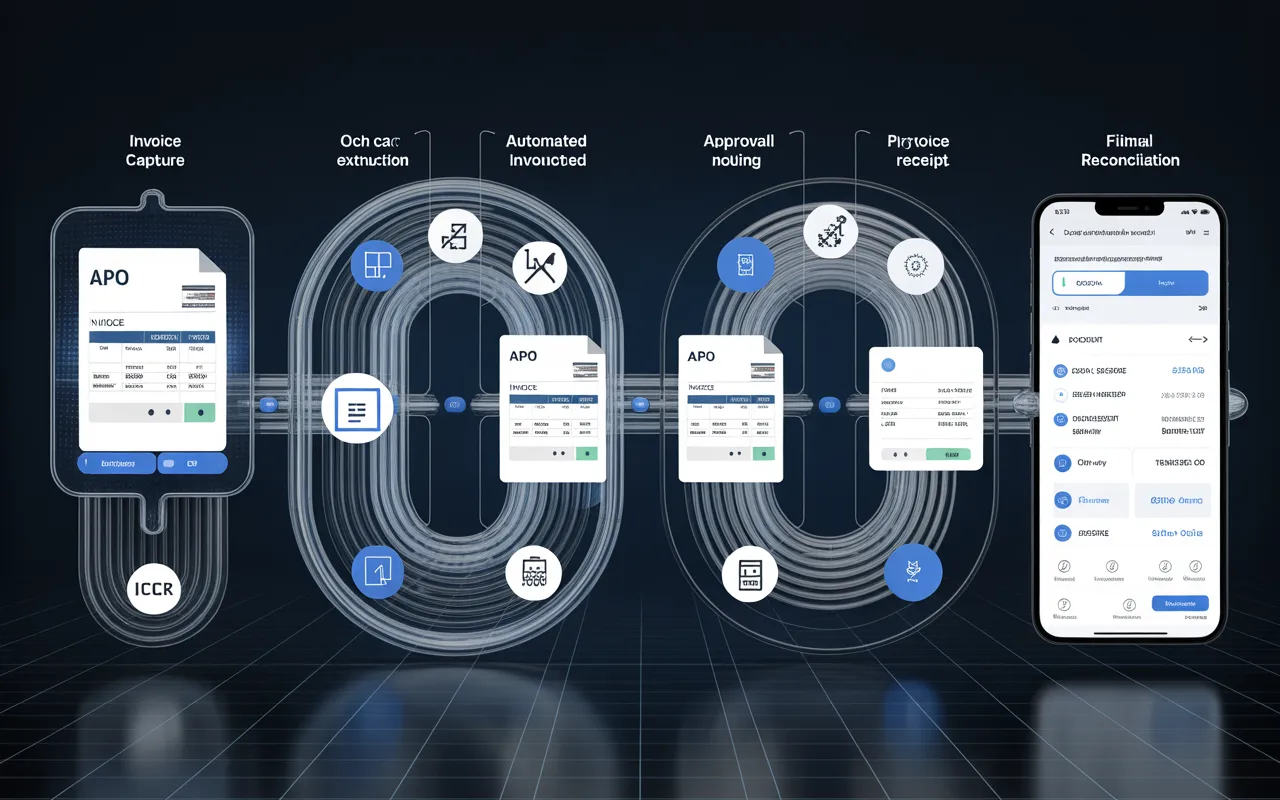
Accounts payable automation transforms supplier invoices into structured digital data and routes them through an intelligent, rule-driven workflow that ends with accurate, timely payments. Instead of relying on fragmented manual steps, the system centralises invoice handling, approval, and payment within a single streamlined environment.
At the beginning of the process, technologies such as Optical Character Recognition (OCR) capture and extract key invoice details automatically. Many modern platforms also incorporate machine learning to continuously improve data accuracy, recognise recurring patterns, and suggest coding or approval paths.
By configuring business rules, such as approval thresholds, tolerance limits, and routing hierarchies, organisations can significantly reduce manual intervention and achieve near-touchless processing for most invoices.
Below are the core stages of the accounts payable automation workflow:
Invoice Capture with OCR and E-Invoicing
The first step in accounts payable automation is converting incoming invoices into a digital format that can be processed efficiently.
This is where OCR technology scans paper invoices, identifies relevant fields such as supplier details, invoice numbers, and amounts, and converts them into structured data. At the same time, e-invoicing allows suppliers to submit invoices electronically in predefined formats, eliminating the need for physical documents altogether.
This dual approach ensures faster intake, reduces manual handling, and minimises the risk of lost or delayed invoices.
Additionally, automated validation checks can be applied at this stage to flag incomplete or incorrect submissions before they enter the workflow.
Over time, the system can also learn supplier-specific formats, improving extraction accuracy and reducing exceptions. This creates a strong foundation for a fully digitised and scalable accounts payable process.
Matching and Verification
Once invoice data is captured, the system performs automated matching against related documents such as purchase orders and goods receipt notes. This process, often referred to as two-way or three-way matching, ensures that the invoice details align with what was ordered and received.
By validating quantities, pricing, and terms, the system can quickly detect discrepancies such as overbilling or duplicate invoices.
Automated verification reduces the need for manual cross-checking and accelerates the review process. Exceptions are flagged and routed to the appropriate personnel for resolution, ensuring that only accurate and compliant invoices proceed further.
This step also strengthens internal controls and reduces the likelihood of fraudulent or erroneous payments. That way, analytics from this stage can highlight recurring supplier issues, enabling better contract management and negotiation strategies.
Approval Workflow
After successful verification, invoices are automatically routed through a predefined approval workflow based on organisational rules.
These rules may consider factors such as invoice value, department, cost centre, or supplier category. The system ensures that the right stakeholders receive approval requests instantly, often through email or mobile notifications, enabling faster decision-making.
Built-in reminders and escalation mechanisms help prevent delays by alerting managers when approvals are pending beyond a specified timeframe. This structured workflow not only speeds up processing but also provides complete visibility into the approval status of each invoice.
Every action is logged, creating a transparent and auditable record of approvals.
Likewise, businesses can customise workflows to adapt to changing organisational structures, ensuring flexibility while maintaining governance and compliance standards across the accounts payable function.
Payment Execution
Once invoices receive final approval, the system initiates the payment process according to predefined schedules and cash flow strategies. Businesses can automate payment runs, select preferred payment methods such as bank transfers or digital payments, and ensure that vendors are paid on time.
When optimising payment timing, organisations can take advantage of early payment discounts or strategically manage working capital. Automation also reduces the risk of missed payments, duplicate transactions, or manual errors associated with traditional payment processing.
Integration with banking systems further streamlines execution, enabling secure and seamless transactions.
In addition, payment notifications can be automatically sent to suppliers, improving transparency and strengthening relationships. This level of control and efficiency contributes to better financial planning, improved vendor trust, and a more predictable accounts payable cycle.
Reconciliation and Reporting
Following payment execution, the system automatically reconciles transactions by matching payment records with bank statements and accounting entries. This eliminates the need for time-consuming manual reconciliation and ensures that all financial records are accurate and up to date.
Any discrepancies are flagged for immediate investigation, reducing the risk of undetected errors. AP automation platforms also generate comprehensive reports and dashboards that provide insights into spending trends, supplier performance, and process efficiency.
These analytics empower finance teams to identify cost-saving opportunities, optimise workflows, and make data-driven decisions.
Plus, having all records stored in a centralised digital system simplifies audit processes and enhances compliance with regulatory requirements. These reporting capabilities transform accounts payable from a transactional function into a strategic contributor to business performance.
It is clear that accounts payable automation delivers a fully integrated, efficient, and scalable approach to managing the entire invoice-to-payment lifecycle. Also, the latter enables your organisations to operate with greater accuracy, visibility, and control.
Why Automate Accounts Payable?
There are several compelling reasons why businesses choose to automate accounts payable, especially as financial operations become more complex and volume-driven.
One of the most immediate benefits is the measurable return on investment. By digitising AP workflows and reducing reliance on manual tasks, organisations can significantly lower processing costs, minimise administrative overhead, and reallocate finance teams toward higher-value strategic work.
Automation also makes it easier to scale operations as the business grows. Instead of hiring additional staff to manage increasing invoice volumes, companies can rely on intelligent systems that handle larger workloads efficiently without compromising accuracy or speed. This ensures sustainable growth while maintaining operational control and consistency.
In addition, AP automation enhances financial visibility and control. With real-time tracking of invoices and payments, finance teams can better manage cash flow, forecast expenses, and make informed financial decisions.
Faster and more reliable payment cycles also strengthen supplier relationships and improve negotiation opportunities.
Key advantages of automating accounts payable include:
- Reduced processing costs through the elimination of manual data entry and paper handling
- Faster invoice processing and approval cycles, improving operational efficiency
- Improved cash flow management with better visibility into payables and liabilities
- Increased ability to capture early payment discounts and avoid late payment penalties
- Enhanced accuracy and reduced risk of human errors or duplicate payments
- Stronger audit trails and compliance through digitised, traceable workflows
- Greater scalability without the need to expand finance teams significantly
- Better supplier relationships due to timely, transparent, and consistent payments
This way, automating accounts payable enables organisations to operate more efficiently, reduce costs, and gain tighter control over their financial processes while supporting long-term business growth.
Top Accounts Payable Tasks to Automate
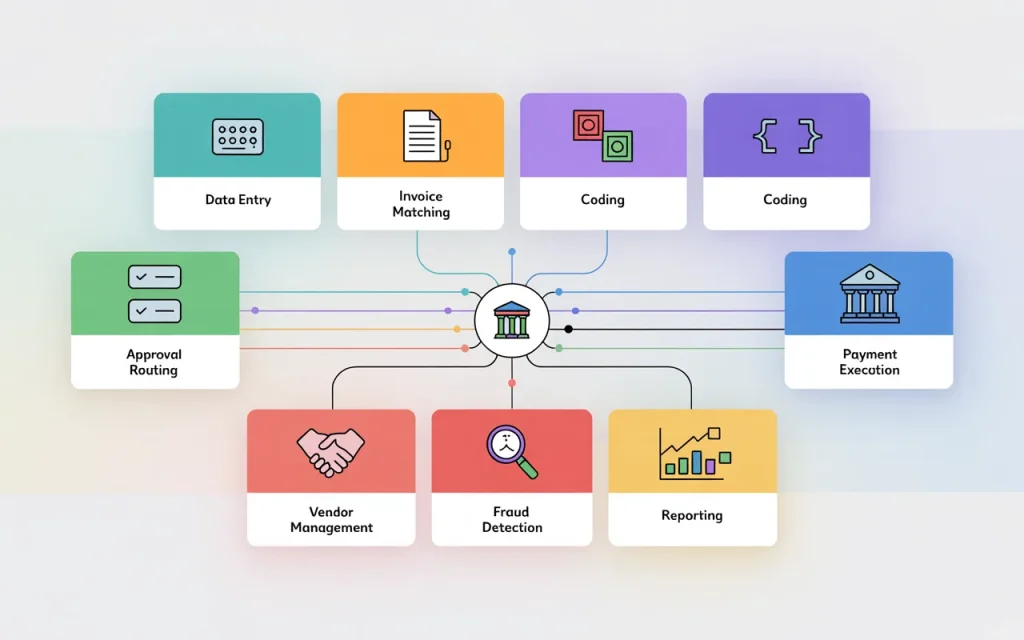
The accounts payable tasks that benefit most from automation are those that reduce processing time, improve accuracy, and lower operational costs. Compared to manual workflows, automation enhances efficiency across multiple AP activities while improving visibility and control.
Data Entry
Automating data capture from invoices and supporting documents significantly reduces the need for manual input. This not only speeds up processing but also minimises human errors such as incorrect entries or missing fields.
Automated systems can extract, validate, and structure data instantly, even from multiple formats, ensuring consistency across records.
Over time, this improves data reliability and allows finance teams to focus on more strategic tasks rather than repetitive administrative work.
Invoice Matching
Automation enables seamless matching of invoices with purchase orders and goods receipts, commonly known as two-way or three-way matching.
This process ensures that billed items align with what was ordered and received.
Automated matching is faster and more accurate than manual comparisons, especially when documents are stored across different systems or locations. It also helps detect discrepancies early, reducing the risk of overpayments, disputes, and delays in processing.
Coding Invoices
With automation, businesses can define rules that automatically assign the correct general ledger codes to invoices. This eliminates inconsistencies and errors that often occur with manual coding.
The system can learn from historical transactions and suggest appropriate coding, improving accuracy over time.
Automated coding also ensures compliance with internal accounting policies and simplifies financial reporting. It also reduces the need for time-consuming corrections during audits or reconciliations.
Approval Routing
Automated workflows ensure invoices are instantly routed to the appropriate approvers based on predefined rules such as amount thresholds or departments. This eliminates delays caused by manual handoffs or misplaced documents.
Real-time notifications, reminders, and escalation paths help keep approvals on track.
At this juncture, the system provides full visibility into approval status. This creates a transparent and auditable process that improves accountability and reduces bottlenecks in the workflow.
Payment Scheduling and Execution
Automation streamlines payment processing by scheduling payments according to due dates and cash flow strategies. This ensures vendors are paid on time while avoiding late fees and penalties.
Automated systems can also prioritise payments to capture early payment discounts and optimise working capital.
Integration with banking platforms further enhances accuracy and security. The latter reduces the risks associated with manual payment handling and improves overall financial efficiency.
Vendor Management
Automated vendor management systems centralise supplier information, including contact details, payment terms, and compliance documents. This ensures data is always up to date and easily accessible.
Automation also helps track vendor performance, communication history, and contract adherence.
By maintaining accurate records and improving transparency, businesses can strengthen supplier relationships, reduce onboarding time, and ensure compliance with contractual and regulatory requirements.
Expense Reporting and Reimbursement
Automation simplifies expense management by enabling employees to capture receipts digitally and submit claims through integrated platforms.
Expenses are automatically categorised and routed for approval, reducing processing time and errors. This ensures faster reimbursements and improves employee satisfaction.
Also, automated checks can enforce company policies, preventing non-compliant claims and providing better visibility into organisational spending patterns.
Fraud Detection
Advanced automation tools use algorithms and data analysis to monitor transactions and identify unusual patterns or suspicious activities. This proactive approach helps detect potential fraud early, reducing financial risk.
Automated alerts allow finance teams to investigate anomalies quickly. Over time, these systems become more effective by learning from past incidents, providing an additional layer of security and strengthening internal controls within the accounts payable process.
Reconciliation
Automation simplifies reconciliation by matching payment records with bank statements and accounting entries in real time. This eliminates manual cross-checking and reduces the likelihood of discrepancies going unnoticed.
Any mismatches are flagged immediately for review, ensuring accurate financial records. Automated reconciliation also speeds up month-end and year-end closing processes, allowing finance teams to maintain up-to-date and reliable financial data with minimal effort.
Tax Compliance and Reporting
Automated systems help calculate taxes accurately based on current regulations and transaction data.
They ensure proper documentation is maintained and generate required reports for compliance purposes. This reduces the risk of errors and penalties associated with manual tax handling. Not to mention that automation keeps records organised and audit-ready, making it easier for businesses to meet regulatory requirements and adapt to changes in tax laws.
Analytics and Reporting
Automation provides detailed insights into accounts payable performance through dashboards and reports. Businesses can analyse spending patterns, identify inefficiencies, and uncover opportunities for cost savings.
Real-time data enables better decision-making and continuous process improvement.
These insights also support strategic planning by highlighting trends, supplier performance metrics, and potential areas for optimisation. It transforms AP into a more data-driven and value-generating function.
What Are the Benefits of AP Automation?

In today’s fast-paced financial environment, accounts payable automation has become a critical capability for organisations aiming to improve efficiency and stay competitive. Beyond simplifying invoice processing, it delivers both operational improvements and strategic advantages across the entire business.
- Enhanced Efficiency
AP automation accelerates the entire invoice lifecycle by removing repetitive manual steps and introducing streamlined digital workflows. Invoices move quickly from capture to approval, reducing processing time and eliminating unnecessary delays.
This enables faster approvals and more consistent payment cycles. As routine administrative tasks are reduced, finance professionals can focus on higher-value activities such as financial analysis, forecasting, and process optimisation.
This ultimately improves overall productivity.
- Improved Financial Accuracy
Automation reduces the risk of human error by standardising data capture, validation, and processing.
This ensures that financial records remain consistent and reliable across all transactions. Accurate data supports better decision-making, strengthens compliance with regulatory requirements, and builds trust with stakeholders such as vendors, auditors, and internal leadership.
Consistent and timely payments also enhance supplier confidence and can improve long-term business relationships and negotiation outcomes.
- Tangible Cost Savings
As it replaces manual processes with automated workflows, organisations can significantly lower operational costs. Expenses related to paper handling, storage, postage, and manual corrections are minimised.
Additionally, reducing errors and delays helps avoid penalties and duplicate payments.
These savings can be redirected toward strategic initiatives, innovation, or business expansion. Plus, the latter allows companies to maximise the value of their financial resources in a competitive market.
- Improved Financial Visibility
AP automation provides real-time insight into the status of invoices, payments, and outstanding liabilities through centralised dashboards and reporting tools. This transparency enables finance teams to monitor cash flow more effectively, identify bottlenecks, and make proactive decisions.
With a clear overview of financial commitments, organisations can improve budgeting, forecasting, and overall financial planning, ensuring better control over working capital.
- Enhanced Fraud Prevention
Modern AP automation systems include built-in controls and monitoring capabilities that help detect unusual or suspicious transactions. Automated checks, audit trails, and approval logs improve accountability and make it easier to investigate anomalies.
Since it is possible to identify risks early, organisations can prevent fraudulent activities, protect financial assets, and maintain strong governance and compliance standards across their accounts payable processes.
It is clear that AP automation empowers businesses to operate with greater speed, accuracy, and control. When they adopt this technology, organisations can unlock both immediate efficiencies and long-term strategic value.
This way, they can position themselves for sustainable growth and stronger financial performance.
How to Select AP Software
Choosing the right accounts payable (AP) automation software is a critical decision that directly impacts operational efficiency, financial accuracy, and long-term scalability. To ensure the solution aligns with your organisation’s goals, a structured and well-planned selection approach is essential.
AP Automation Software Selection Steps
Planning
Start by forming a cross-functional team that includes finance, IT, and key stakeholders. This group should define clear objectives for AP automation, such as reducing processing time, improving accuracy, or enhancing visibility.
Establishing measurable goals early ensures alignment across departments and sets a strong foundation for the selection process.
Requirements Gathering
Next, document your current AP workflows in detail, identifying inefficiencies, bottlenecks, and manual dependencies.
Based on this analysis, create a comprehensive list of functional and technical requirements for the new system. These requirements are then used to develop a request for proposal (RFP), which is shared with shortlisted vendors that match your criteria.
Vendor Evaluation
Once proposals are received, assess each vendor carefully. Compare their features, implementation approach, pricing models, and ability to meet your requirements. It is important to evaluate not only the software capabilities but also the vendor’s experience, support structure, and long-term reliability.
Vendor Selection
In the final stage, conduct deeper evaluations of the top candidates.
This may include product demonstrations, pilot testing, or detailed discussions with vendors.
Review how well each solution fits your workflows and technical environment before making a final decision that delivers maximum value.
AP Automation Software Requirements Checklist

To identify the most suitable AP automation solution, consider the following key criteria:
Understand Your Needs
Begin with a detailed assessment of your accounts payable processes, transaction volumes, and operational challenges. This helps prioritise essential features and ensures the solution addresses real business needs.
Scalability and Flexibility
Choose software that can grow with your organisation and adapt to changing business requirements. A scalable system ensures long-term usability without frequent upgrades or replacements.
Integration Capabilities
Ensure the solution integrates seamlessly with existing systems, including ERP platforms, accounting software, and financial tools. Smooth integration prevents data silos and enables efficient information flow.
User-Friendliness
An intuitive interface is crucial for quick adoption. Easy-to-use software reduces training time, minimises user errors, and improves overall productivity across teams.
Advanced Features
Look for capabilities such as OCR for automated data capture, machine learning for intelligent processing, and analytics tools for performance insights. These features enhance efficiency and decision-making.
Security and Compliance
The software should include strong security measures to protect sensitive financial data. It must also support compliance with regulatory requirements and maintain proper audit trails.
Vendor Reputation and Reviews
Research the vendor’s track record, customer feedback, and industry presence. A reliable vendor ensures ongoing support, regular updates, and a stable product roadmap.
Cost Considerations
Evaluate the total cost of ownership, including implementation, licensing, maintenance, and future upgrades. Select a solution that balances cost with long-term value and performance.
Support and Training
Ensure the vendor provides comprehensive onboarding, training resources, and ongoing technical support. Strong support services are essential for successful implementation and continued usage.
Customisation Capabilities
Since every organisation has unique workflows, the software should allow configuration and customisation to align with specific operational needs and business rules.
Selecting the right AP automation software requires a combination of internal evaluation and thorough vendor assessment. If you follow a structured approach and focus on key requirements, you can invest in a solution that delivers efficiency, accuracy, and sustainable long-term value.
Embracing a Smarter Financial Future
Accounts payable automation is a step toward clarity, control, and confidence in your financial operations. Since it is possible to reduce manual burdens and improve accuracy, your businesses can empower your teams to focus on what truly matters. In a fast-changing world, embracing automation means building stronger relationships, smarter decisions, and a future-ready organisation.
FAQs About Accounts Payable Process Automation
Accounts payable process automation is the use of digital tools to manage invoice processing, approvals, and payments with minimal manual effort. It replaces paper-based workflows with automated systems, improving accuracy, speed, and financial visibility across the entire invoice-to-payment cycle.
Accounts payable automation improves efficiency by eliminating manual data entry, accelerating approvals, and streamlining invoice processing. Automated workflows reduce delays, minimise errors, and enable faster payments, allowing finance teams to focus on strategic tasks instead of repetitive administrative work.
Common tasks that can be automated in accounts payable include invoice capture, data entry, invoice matching, approval routing, payment processing, reconciliation, and reporting. Automation ensures these processes are faster, more accurate, and easier to track compared to manual methods.
AP automation helps businesses reduce processing costs, improve accuracy, enhance cash flow visibility, and prevent fraud. It also enables faster payments, captures early-payment discounts, and strengthens supplier relationships, while providing real-time insights for better financial decision-making.
To choose the best AP automation software, evaluate your business needs, integration capabilities, scalability, and ease of use. Consider features such as OCR, analytics, and security, and review the vendor’s reputation, support services, and total cost to ensure long-term value.