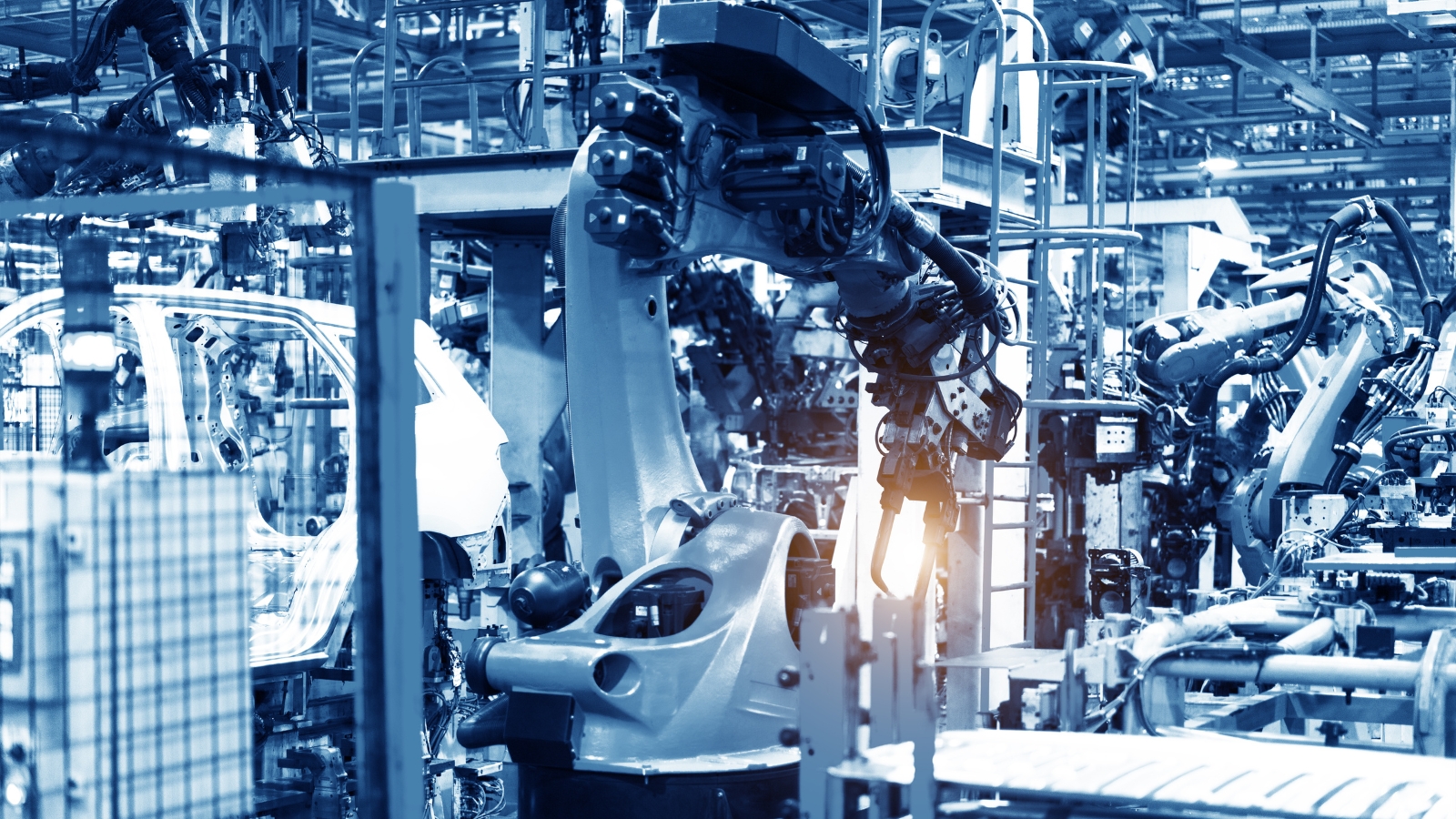
These days, the majority of car production lines all over the world are automated. The auto manufacturing industry is now free of the clanking, sparking chaos. Something that is quieter, more precise, and more self-aware has taken its place. The robotic arms move with balletic finesse. Welds and panel gaps are photographed in milliseconds. An algorithm in a control room is working away, predicting which machine will need service next Tuesday.
This AI in automotive manufacturing is happening in 2026! It is not a far-off sci-fi dream but a working everyday reality. With a CAGR of 54.1%, artificial intelligence is certainly no longer a buzzword. It has entered every conceivable phase of vehicle manufacturing, be it initial sketches or a finished moving car.
In this article, we will properly examine AI impacts on the automotive manufacturing industry, what technologies are behind the changes, what challenges remain, and what the future could potentially hold in this area.
We will examine
Why AI Matters So Much to Car Manufacturers Right Now
We know that the manufacturing sector has long been tested by the automobile industry.
A century ago, Henry Ford’s assembly line changed industrial production, and today’s manufacturers are facing similar pressures to reinvent themselves. This time it is all about electrification, tightening emissions regulations, the fragility of global supply chains, and consumers’ desire for better value and faster delivery.
This is when AI and machine learning in car manufacturing provide a way to tackle these pressures head-on. Unlike traditional automation, which performs predictable, pre-programmed actions, AI systems are capable of learning from data, adapting to new circumstances, and making real-time decisions.
As you can see, this distinction is what differentiates a simple automated factory from a factory that is now referred to as a smart factory.
Plus, manufacturers benefit from fewer defects, less downtime, reduced cost, and faster times to market.
For consumers, that often means more reliable arrivals of safer, better-built vehicles. Cloud technology is freeing financial services from the high costs of maintaining in-house systems.
Key Takeaways
- AI is now embedded across automotive manufacturing—driving predictive maintenance, quality inspection, robotics, and supply chain forecasting.
- Technologies like computer vision, digital twins, and cobots are helping manufacturers cut defects, downtime, and safety risks simultaneously.
- Robust software platforms can bring these AI capabilities together in one system, connecting shop-floor data with real-time decision-making.
- The result is measurable: less downtime, lower costs, and faster, smarter production without compromising quality.
The Role of AI in Automotive Manufacturing
AI is transforming automotive manufacturing by powering predictive maintenance, quality inspection, robotics, and supply chain optimisation — helping car makers cut downtime, reduce defects, and speed up production while improving worker safety across the assembly line.
1. Robotics and Intelligent Automation on the Assembly Line
The use of robotics in car manufacturing has been around since the 1960s. However, today’s robotic arms used in factories have very little similarity to robots of the past.
Traditional robots would continuously repeat the same action regardless of the situation around them. Yet, artificial intelligence (AI) powered robotics can sense everything around them and respond with appropriate action. In other words, they can also work alongside human workers directly.
These robots, called cobots (for collaborative robots), are fitted out with sensors and computer-vision systems; thus, they can safely work alongside people on the factory floor. Cobots are designed to share a workspace with humans in factories and are highly equipped to shoulder jobs that might put humans in danger or are too intensive for humans.
Robots can use machine learning algorithms that allow them to optimise their performance over time, improving the accuracy of their outcomes. Error rates are gradually reduced without engineers’ involvement in reprogramming.
The impact on the structure of the labor force is also noticeable.
Many manufacturers, rather than simply replacing human workers entirely, have caused advances in AI-driven robotics to change the nature of jobs on factory floors. As a result, demand is growing for technicians who will oversee, train, and maintain intelligent systems instead of performing manual tasks themselves.
2. Predictive Maintenance: Fixing Problems Before They Happen
AI predictive maintenance, which identifies when a machine needs repair, is extremely valuable. Let’s explore the reasons.
You know that production lines in a facility can incur enormous costs due to unplanned downtime. For instance, the cost of one assembly line sitting idle can cost a manufacturer hundreds of thousands of dollars every hour.
Traditionally, at the factories, they followed scheduled maintenance to service the engineering equipment at certain intervals, whether they required it or not. The method is not perfect in any way since machines may get serviced early, wasting time and resources. On the other hand, machines may fail in between.
In this context, Artificial intelligence modifies everything.
Sensors that monitor a machine’s vibration, temperature, sound, and other indicators are fitted on equipment. Machine learning models that have a continuous feedback loop watch for those indicators.
As they filter through the data, they pick up patterns that foretell a breakdown. In fact, often long before a human technician would notice anything wrong, a failure event could be observed in the data- perhaps a week, maybe even longer. The system detects the fault, schedules a fix during pre-planned downtime, and the fault does not happen.
This system not only reduces downtime, but delays overall stoppage of expensive machinery causing interference or breakdown. More importantly, it improves workplace safety and catches faults before they become dangerous.
3. AI-Powered Quality Control and Computer Vision
For years, quality control in car manufacturing has been quite labor-intensive. This is because of the reliance on humans who would inspect paintwork, panel alignment, welds, and many more details. Humans excel at this task, but they tire out, blink, and simply are not fast enough to check every unit at the speed required by modern production lines.
However, a segment of AI that is trained to interpret images and vision is known as computer vision.
A deep learning model that analyses images from high-resolution cameras can scan a vehicle body in a few seconds. Whether it is a hairline scratch, a slightly misaligned panel, or a paint thickness inconsistency, the model can easily identify these microscopic defects.
As these systems are trained on enormous datasets of both flawless and flawed components, their accuracy tends to improve continuously as more data flows through them.
It was impossible to achieve a similar level of consistency before. However, all vehicles can now be inspected to the same standard, rather than spot checks or sampling.
For manufacturers, it means fewer recalls, fewer warranty claims, a stronger brand reputation.
4. Digital Twins and Simulation-Led Design
Before engineers even begin to create any physical part, a lot of engineering these days takes place within the computer, making use of the concept of a ‘digital twin’. The latter is a sort of virtual data-rich twin of a physical product, process, or factory.
Using AI technologies, engineers can analyse and enhance greater designs more effectively compared to before.
With AI, an engineer is able to create tens of thousands of design variations and virtually test them before tooling expensive dies or building costly prototypes.
Interested in seeing the performance of a new chassis design in a side-impact collision? Or how the throughput at the factory assembly line layout will be affected by a redesign? A digital twin can be used to model that scenario with an impressive level of accuracy using a machine learning model trained on past performance data.
In 2026, entire factories now have digital twins, allowing plant managers to simulate changes to production schedules, equipment layouts, or supply routes and watch the likely knock-on effects before ever making a single change to the real factory floor.
It is a very effective way of ‘testing’ cognition in the world without the cost, time, or business disruption.
5. Generative Design: Letting AI Help Engineer the Car
There are a plethora of interesting applications that use AI in automotive engineering, which are helping the automotive engineers in more ways than you can imagine.
In recent times, the use of generative design has become very popular. This is one of the more genuinely exciting applications, particularly as CAD and CAM software has advanced. As a result, instead of the engineer, by trial and error, sketching off a component and iterating, this presents the engineer with unexpected options.
The design problem is analysed and responded to by an algorithm in generative design.
This method is already producing components that are not anything that a human engineer would design. They are likely to be organic, lattice-like structures using less material while maintaining or improving structural strength.
AI-supported optimisation of materials can be highly useful for an industry that constantly faces pressure to reduce the weight of vehicles for either fuel economy or EV range.
Did you notice? Design iterations that once took engineering teams weeks can now be explored by an algorithm in hours.
The best thing is that it frees human engineers to focus on selecting and enhancing the best candidates instead of generating them from scratch. It greatly reduces the development period.
6. Supply Chain Optimisation and Demand Forecasting
If you closely monitor the automotive industry, you might be aware of the fact that many sub-industries have fragile global supply chains. And that issue arises so often because automobiles offer a variety of components.
Manufacturers have been left scrambling at different points due to semiconductor shortages, shipping delays, and raw material price swings.
Let’s talk about the supply chain disruption in manufacturing: Over the past year, we have seen manufacturing supply chains cope with all sorts of unpredictable external shocks. Several global events, such as record heatwaves, the pandemic, and the war in Ukraine, have made it difficult for suppliers to build resilience.
However, we have stepped into an era where manufacturers will use artificial intelligence to forecast and cope with a growing number of supply chain shocks. As a part of that, Machine Learning aids in analysing large volumes.
Further, AI-powered forecasting tools can help manufacturers ensure the volume of production matches consumer demand, taking into account everything from local economic data to seasonal buying patterns.
On the demand side, every touchpoint matters. They reduce the chances of overproduction, which can lead to capital being blocked in unsold products, and underproduction, which causes downstream dealers and customers to be frustrated.
7. Autonomous Vehicle Testing and Development
Although most of the public debates surrounding AI and cars focus on the self-driving cars themselves, it is worth remembering that AI also plays a big role in how the vehicles are developed and tested in the first place.
The ability to simulate millions of driving scenarios in the virtual world, including rare, dangerous edge cases that would be far too risky to test on public roads, enables engineers to train and validate far more extensively than is possible through physical testing.
This simulation-first approach extends to advanced driver-assistance systems (ADAS) in ordinary vehicles, such as emergency braking, lane-keeping, and adaptive cruise control, which are also built on machine learning models trained on huge piles of driving data.
Challenges and Limitations Manufacturers Still Face
Portraying AI adoption in automotive manufacturing as a smooth and frictionless exercise would be slightly misleading. Manufacturers continue to wrestle with real challenges.
- Small manufacturers and suppliers do not have the cushion of large automotive groups. High implementation costs continue to be a big barrier.
- Moreover, in order to add the sensors, connectivity, and computing infrastructure needed to support AI systems, it can be a hefty upfront cost to retrofit older plants.
- Another frequent pain point is data quality and integration issues. The effectiveness of artificial intelligence (AI) models lies in the data they are trained on. A majority of manufacturers are working with old systems that do not interact with each other easily.
- As a result, it becomes complicated to establish the requisite streamlined data pipelines to train such sophisticated AI models.
- Adapting to the workforce is also a concern. Manufacturers must make a serious investment in retraining programmes for current employees instead of displacing them, as the manufacturing role shifts away from manual repetitive tasks and more towards monitoring and managing intelligent systems.
- Ultimately, cybersecurity is a growing concern. With the increased connectivity of factories, they are now more vulnerable to cyberattacks, and if the production systems are impacted, it could be severely disruptive.
The Road Ahead: What is Next for AI in Car Manufacturing
As we can see from here in 2026, the next phase of AI adoption in this sector is likely to be driven by a few trends that are emerging. Do you agree?
According to the report, there will be deeper integration of AI throughout the vehicle life cycle. From design and manufacturing to after-sales service, AI has already been used to predict when a vehicle will need maintenance.
Not just equipment on the factory floor. But also vehicles that are already on the road.
Also, automotive manufacturing is starting to see the early phases of generative AI tool adoption. Other industries have already experienced this adoption, and automotive manufacturing receives help with technical documentation and troubleshooting production issues that draw on internal knowledge bases.
However, sustainability pressures will encourage the manufacturing industry to make greater use of optimisation powered by AI. This will go a long way in order to cut down energy consumption, wastage of material, and carbon emissions throughout their operations.
Even small improvements in efficiency can add up to a meaningful difference for the environment when done at scale.
Transform Automotive Manufacturing With Cerexio Manufacturing Execution System
Cerexio Manufacturing Execution System (MES) delivers complete visibility across your company’s automotive production by connecting machines, operators, production lines, quality inspections, inventory, and scheduling within one intelligent platform.
The Cerexio system streamlines manufacturing workflows, ensures full traceability, improves production accuracy, minimises downtime, and enables manufacturers to achieve higher efficiency, consistent quality, and operational excellence.
Unlock AI-Driven Automotive Production With Industry 4.0 Capabilities
Cerexio MES combines artificial intelligence, intelligent automation, predictive analytics, digital twins, Industrial IoT connectivity, and real-time monitoring to optimise every stage of production.
These Industry 4.0 capabilities predict equipment failures, automate workflows, reduce material waste, lower maintenance and labor costs, improve Overall Equipment Effectiveness (OEE), and maximise profitability across automotive manufacturing operations.
Call for a personalised demo.
Cerexio-AI Power Smoothly Integrated
From Assembly Line to AI Line: What Comes Next for Car Makers
The automotive manufacturing industry is slowly becoming more efficient and smarter with the implementation of AI, but it is not just one technology or one moment of change. AI is gradually reshaping how we design and control vehicles. It plays a role in automotive manufacturing by enhancing the vehicles through design testing, production, and operational roll-out. Artificial intelligence is everywhere in modern car factories, from predictive maintenance and computer vision quality control to generative design and digital twins. It is now the connective tissue that runs through it all.
This does not imply that humans will no longer play a part. The companies achieving the most success appear to view AI as something that will empower skilled workers, rather than having AI replace them altogether. The factories of the future will have no people, but people and intelligent systems working in real partnership. Each will be doing what they do best.
As the technology matures further, one thing seems reasonably safe to predict: those automotive manufacturers which embrace AI smartly and not reluctantly will be the ones setting the pace for the rest to follow.
FAQs About the Role of AI in Automotive Manufacturing
AI predictive maintenance analyses sensor data—vibration, temperature, acoustics—from robotic arms and machinery using machine learning models. It detects anomalies before failures occur, scheduling repairs proactively. This reduces unplanned downtime, extends equipment lifespan, and lowers maintenance costs across production lines.
Computer vision systems use trained neural networks to scan components and welds at high speed, detecting micro-defects invisible to human inspectors. They compare images against reference standards in milliseconds, flagging deviations for correction before assembly continues downstream.
Digital twins are virtual replicas of physical production lines, fed real-time data from IoT sensors. Manufacturers simulate process changes, test layouts, and predict bottlenecks before implementing them physically, reducing costly trial-and-error on the actual factory floor.
Time-series forecasting models, such as LSTM neural networks and gradient boosting algorithms, analyse historical demand, supplier lead times, and market signals. These techniques predict parts shortages and demand fluctuations, enabling manufacturers to adjust procurement and inventory dynamically.
Cobots use force-sensing technology and AI-driven motion planning to work safely alongside humans without safety cages, unlike traditional robots isolated for safety. They handle precision tasks—fastening, welding assistance—while adapting in real time to human movement.