
Did you know that small layout decisions can have big consequences in US$14.26 trillion worth of high-volume manufacturing? High performance is made or broken by even the smallest layout decisions! A poorly designed factory layout leads to delays, waste, and spiralling costs; the right structure supports speed, consistency, and scale. This is where product layout operations management seeks to arrange workers, machines, and tasks in such a way as to create the smoothest flow. This layout model is what drives modern mass production, from auto plants to electronics factories.
In this guide, we examine how product layouts operate, why they are superior to other types of layouts in continuous manufacturing, and how your company can use them strategically to achieve greater efficiency, lower costs, and predictable output.
We will explore
- What Is Product Layout in Operations Management?
- What Are the Core Characteristics of Product Layout?
- What Are the Different Types of Product Layout Systems?
- How Does Product Layout Compare to Process and Fixed-Position Layouts?
- What Are the Key Benefits of Product Layout in Manufacturing?
- How Does Product Layout Enable Cost Reduction?
- What Are the Strategic Implementation Steps for Product Layout?
- How to Perform Line Balancing in Product Layout Design?
- What Challenges Arise When Implementing Product Layout?
- How to Optimise Product Layout Performance?
- What Role Does Technology Play in Modern Product Layouts?
- How to Measure Product Layout Efficiency?
- FAQs About Product Layout Operations Management
What Is Product Layout in Operations Management?
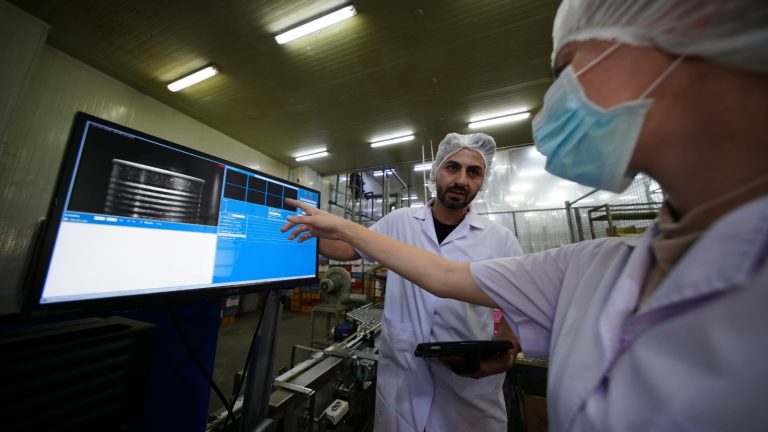
This section explores the concept, objective, and role of product layout in contemporary production systems.
Key Takeaways
- Product layout operations management is well-suited to standardised mass production, enabling the highest efficiency and output.
- Workstation layout and flow should minimise downtime, material handling, and labour.
- Optimisation involves line-balancing techniques, automation, and real-time monitoring (for continuous improvement).
- The adoption of technology such as MES, IoT, and AI brings predictability and efficiency in resource use and throughput to manufacturing facilities.
Defining Product Layout and Its Fundamental Principles
Product layout operations management organises resources based on the exact sequence of a production process, and ensures that each workstation arrangement provides a smooth sequential operations workflow.
The underlying principle is simplicity. This means operations are carried out in a strict sequence to ensure steady output, high speed, and quality in stable mass-production conditions.
The Role of Sequential Arrangement in Production Efficiency
When you arrange product layouts in a fixed order, they reduce backtracking and the amount of material flow time needed. This configuration improves the manufacturing efficiency by decreasing handling time and enhancing station synchronisation.
This is where sequential positioning also helps guarantee that material will move continuously and consistently through the line.
How Product Layout Differs From Other Facility Layouts
There is a need for high production, and unlike the other layouts, such as process layout, cellular layout, or fixed position layout, you cannot arrange product layout according to the process (as in process layout). That is because you have to arrange it according to the end product!
Further, it values flows more than flexibility; it is suitable to be adopted as a scheduled and reconfigurable operating system in mass production systems characterised by low product variety but high output regularity demanded quickly.
What Are the Core Characteristics of Product Layout?
An understanding of these attributes explains why product layouts are so common in a high-volume production environment.
Linear Workflow and Unidirectional Material Flow
It uses a straight, uncontaminated workflow design, with material flowing in only one direction. In this configuration, there is no impeding cross-traffic or factory floor confusion.
Plus, it increases operational efficiency and minimises the delays caused by unnecessary movement or handling errors.
Specialised Workstations Arranged in Production Sequence
The product layout station’s job is pre-defined for the work on the assembly line production. Machines, labour, and tools are arranged for speed and precision to facilitate the right equipment placement.
This way, you can see that every operation adds value without disturbing a seamless production rhythm.
Standardisation and Repetitive Task Specialisation
Product layout thrives on standardised products, and repetition is a driving factor. One person does one thing, and given how such repetitive work makes people more efficient at it, that means faster, more consistent, higher-quality output.
As you can see, this redundancy reinforces quality results while facilitating training, supervision, and long-term performance predictability from production line to production line.
What Are the Different Types of Product Layout Systems?
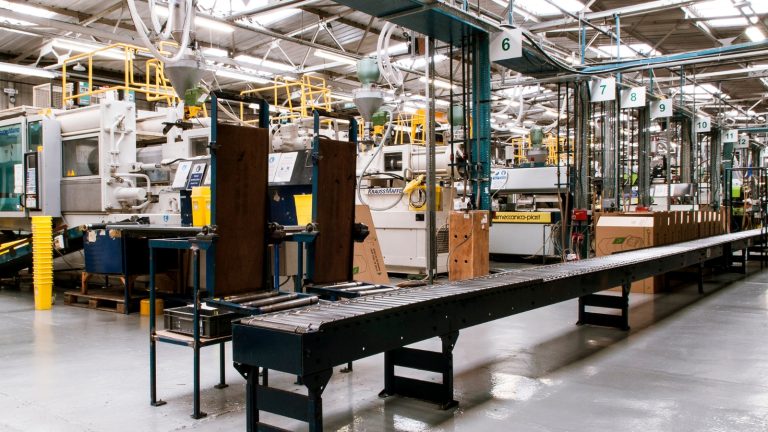
All product layout systems vary with respect to production rate, degree of automation, and the magnitude of volume requirements.
Assembly Line Layout for Sequential Product Building
Assembly line layout design segregates the production into well-defined stages, each of which creates a part or adds a feature. This system shines in situations where it requires high-speed production, optimising synchronisation.
Also, it decreases the amount of dormant time to ensure uniform production output over a range of standardised products.
Continuous Flow Layout for Uninterrupted Production
Continuous flow production can run continuously without stopping, great for the chemical, food, and energy industries. Items flow endlessly through machinery, making more with less downtime, buffering, and hands-on steps from start to finish, increasing production volume.
Transfer Line Systems With Automated Material Handling
Transfer lines combine machines, with automated conveyor systems transferring work-in-progress between operations. Such systems are being considered for high-end facilities with a focus on production scheduling, automation, and repeatability rather than speed, workforce intensity, and accurate materials purchasing (all of which benefit 3D Printers).
How Does Product Layout Compare to Process and Fixed-Position Layouts?
This comparison makes it easy for companies to decide on the appropriate layout according to volume, variety, and movement.
Product Layout vs Process Layout: Volume and Variety Considerations
Product layout is characterised by high volume and low variety, where process layout enables customisation and flexibility. The product’s layout provides lower cost, greater speed, and better resource utilisation when demand is stable and pays for similar products being produced.
Product Layout vs Fixed-Position Layout: Mobility and Scale Factors
In a fixed-position layout, the products do not move across the shop floor; instead, resources are brought to them. In product layout, this logic is reversed, with the part moving from station to station.
This has the effect of simplifying product design for mass production, where portability, speed, and repetition supersede customisation.
When to Choose Product Layout Over Alternative Configurations
Product layout works best when demand is forecast, products are unvarying, and output goals are high. Product layout operations management is suitable for companies that are big on scale, cost-effectiveness, and high throughput.
What Are the Key Benefits of Product Layout in Manufacturing?
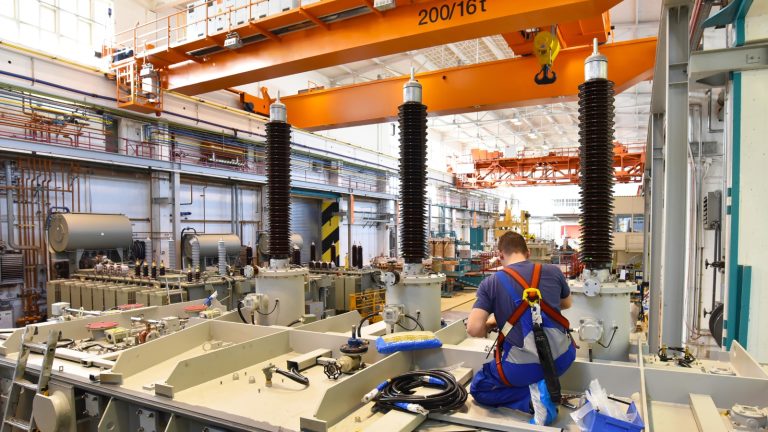
In this section, we will discuss the reasons why product layout is still considered the best layout for process layout on high-volume manufacturing operations.
Maximised Production Efficiency and Throughput Rates
Product layout arranges all the equipment in a determined line. This leads to a low gap between every operation.
Such a structure increases throughput by running the workflow continuously. This indicates that manufacturers are able to maintain throughput levels with speed, reliability, and confidence across the entire production line.
Reduced Material Handling and Transportation Costs
When materials do not have to go through a long route, it not only cuts down on unnecessary movement but also on distance. Therefore, straight-line layouts are recommended.
Simple fix needs less material handling, which lowers fuel, labour, and equipment costs and minimises damage risk. This facilitation of the process helps with faster processing and the necessary switching of production stages.
Simplified Production Planning and Quality Control Processes
How do standardised workflows help in production planning?
These checkpoints, which can be utilised for quality checks, would enhance and strengthen quality control with a limited number of inspections. Managers get more visibility into process performance, and they can detect deviations or defects in processes faster.
How Does Product Layout Enable Cost Reduction?
One of the strongest competitive edges yielded by product layout systems is cost efficiency.
Lower Labour Costs Through Task Specialisation
In product layouts, employees do the same kind of work over and over, resulting in faster and more accurate work. This specialisation decreases the overall training time and labour variation with enhanced performance.
With increasing efficiency comes the need for a smaller team per unit, and thus it reduces the labour costs dramatically.
Minimised Work-in-Process Inventory Levels
Continuous flow minimises queuing and waiting between stages, reducing work-in-process. This is where reducing inventory on the line equals more capital, better cash flow, and a reduction in storage.
Further, it helps track and handle costs at every stage of the manufacturing cycle.
Economies of Scale in High-Volume Production
The product layout is the appropriate system to use in mass production, where fixed costs are divided evenly among high volumes. This construction allows for increased production capacity, higher output, lower individual piece costs, and the ability to play hardball on price without sacrificing quality.
What Are the Strategic Implementation Steps for Product Layout?
The establishment of a policy is strongly influenced by structured planning, good data, and disciplined execution.
- Step 1 – Conducting Product Analysis and Demand Forecasting
Execution starts with the assessment of the design of a product, demand trends, and volume stability. Reliable predictions inform layout decisions and help to guarantee that the system meets long-term output targets without the need for reconfiguration or facing capacity disparities that disrupt production.
- Step 2 – Determining Workstation Tasks and Cycle Times
You can divide each operation into individual jobs, and you can allocate them to stations according to their respective cycle time. Good task schedules balance the load, eliminate idle time, and ensure smooth handovers between stages without overloading workers or machines.
- Step 3 – Balancing Production Line for Optimal Efficiency
You can rebalance work utilising established line-balancing techniques. Balanced lines minimise wait times, add uniformity to processing, and prevent clogs that inhibit flow – allowing the layout to operate at or near its intended capacity.
How to Perform Line Balancing in Product Layout Design?
Line balance guarantees that each station will be contributing equally to the cumulative goal.
Calculating Takt Time and Production Rate Requirements
Takt Time is the rate at which you need to produce products to satisfy demand. Plus, since the takt time is based on the required production volume, managers will evenly distribute work.
This way, no station overproduces, lags behind, or has excessive idle time.
Assigning Tasks to Workstations for Balanced Workload
In this context, tasks are grouped based on duration, precedence, and skill requirements. Balanced assignment ensures each station contributes equally to output goals, improving resource utilisation while maintaining consistent performance across the entire production line.
Minimising Idle Time and Bottleneck Identification
You can classify jobs according to length, precedence, and skill requirement. Balanced allocation allows all stations to contribute reasonably towards production metrics so as to better utilise equipment and still keep good performance of the whole line.
What Challenges Arise When Implementing Product Layout?
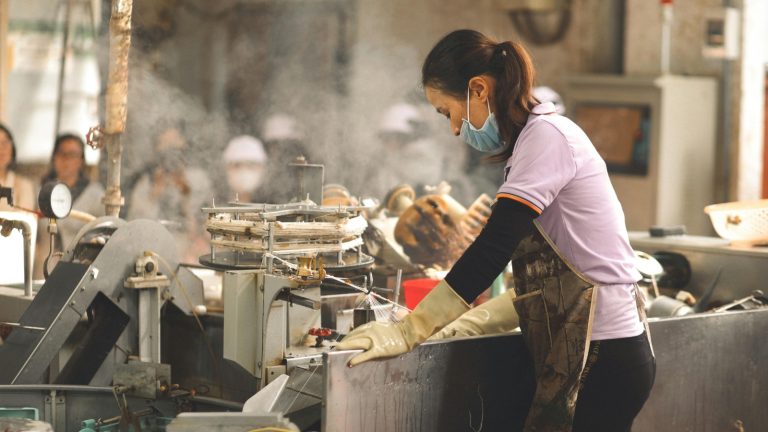
As much as it comes with plus points, product layout has some inherent risks that you need to take into consideration.
Limited Flexibility for Product Variety and Customisation
Product layouts are designed to capitalise on repetition. This means they do not work as well with frequent design changes.
The higher the degree of customisation, the more expensive and time-consuming it is to reconfigure stations. This makes companies less responsive to a dynamic market and to the short life cycles of their products.
High Initial Investment in Specialised Equipment
To create a product’s layout, it is necessary to have special machines and tooling. These costs raise the financial stakes, particularly if demand predictions are revised.
After the investment in these devices, it is not easy to transfer equipment or resources for other purposes without additional capital.
Vulnerability to Production Line Disruptions and Downtime
A single breakdown can bring the whole line to a stop. Without buffers or parallel paths, disturbances ripple through the shop floor, immediately affecting the delivery schedule and performance.
This is why you need proactive planning and a quick response to avoid downtime impacts.
How to Optimise Product Layout Performance?
Optimal operations need to keep the flow stability while enhancing system performance incessantly.
Implementing Continuous Improvement Methodologies
Applying continuous improvement can aid teams in uncovering inefficiencies, reducing waste, and helping stabilise flow. Small changes make it easier to become more reliable, responsive, more versatile, and state-of-the-art as you can maintain excellence for years without the need for significant layout overhauls either.
Leveraging Automation and Robotics for Efficiency Gains
Automation systems receive and process products in contemporary product layouts where routine operations are becoming ever more common. It is evident that robots enhance speed, accuracy, and consistency with less reliance on human labour.
Naturally, automation also adds to safety and the possibilities of growth on a larger scale.
Using Real-Time Monitoring Systems for Bottleneck Detection
The real-time status of lines is immediately available on digital dashboards. Managers receive instant alerts to see potential delays in advance and, if necessary, quickly re-establish the balance flow, preventing small inefficiencies from blowing up into larger disruptions.
What Role Does Technology Play in Modern Product Layouts?
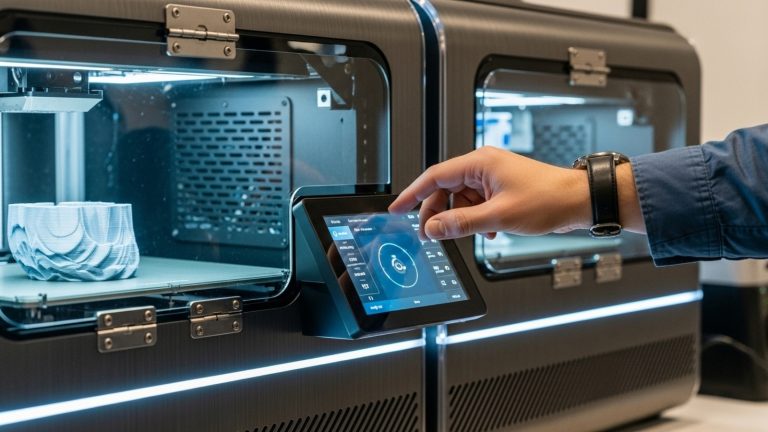
Let’s explore how innovative technologies are transforming classical product configuration into smart manufacturing systems.
MES Integration for Real-Time Production Tracking
Machines, operators, and data streams are linked together into one platform through Manufacturing Execution Systems. Adequate MES visibility enhances decision-making, reinforces process discipline, and ensures harmonised execution across all phases of production with no latency from manual reporting.
IoT Sensors and Predictive Maintenance Capabilities
Sensors connected to IoT track down the health of machines and operating conditions all the time. Proactive intelligence will enable maintenance to be performed before failures happen, mitigate unplanned downtime, and extend the life of equipment throughout your production environment.
AI-Driven Production Scheduling and Optimisation
AI algorithms are used to evaluate constraints, demand patterns, performance data, and more to improve production scheduling. And these systems are constantly optimising workloads, reducing delays and enhancing consistency, enabling more informed planning in a complex, high-volume manufacturing environment.
How to Measure Product Layout Efficiency?
Measurement guarantees that the design is achieving anticipated operational and financial results.
Tracking Production Output and Cycle Time Metrics
Monitoring the amount and timing of outputs is important to evaluate line stability. When measurements are consistently collected, inefficiencies, lag, and trending behaviors can be unearthed with no interruption of the daily routine.
Monitoring Line Efficiency and Overall Equipment Effectiveness (OEE)
OEE aggregates availability, performance, and quality into one measure. This metric also allows monitoring how well equipment is meeting production targets and identifying opportunities for improvement.
Analysing Material Flow and Waste Reduction Indicators
Flow analysis helps to find excess motion and to understand delays and the sources of waste. By eliminating these inefficiencies, product layout performance is in line with lean manufacturing principles, providing speed, consistency, and cost economy.
Why Choose Cerexio for Product Layout Optimisation?
CerexioMES is a digital-first Manufacturing Execution System that takes traditional layout practices to the next level through Industry 4.0 technologies.
Advanced MES and Manufacturing Control Tower Solutions
Cerexio’s MES systems allow unified views into the operations. With this solution, you can control towers, integrate machines, and system data to help your production teams make decisions in advance and better synchronise across production environments.
Real-Time Production Monitoring and Analytics Capabilities
With analytics in real-time, CerexioMES makes it possible for manufacturers to spot inefficiencies immediately. Fact-based insights give managers the tools they need in order to ensure flow is optimised, delays are minimised, and performance remains steady at scale.
Industry 4.0-Powered Automation for Maximum Efficiency
Cerexio employs Industry 4.0 for the layout design. Connected systems and intelligent analytics provide integrated, smart automation that delivers faster, more reliable, and more competitive manufacturing.
Ready to Transform Your Production Layout?
Cerexio’s experts first study your production site, recognise layout phasing weaknesses, and provide data-based improvement concepts. All of which will be entirely achievable with expert help to smooth the transition and accelerate the realisation of benefits.
Schedule a consultation with Cerexio operations experts.
Discover How Optimised Layout Can Boost Productivity by 40%
Well-designed product layouts minimise waste, stabilise flow, and enhance coordination. If you wish to see enormous production gains, keep your plant layout tuned to meet demand, technology, and discipline.
Cerexio-Begin Your Journey Toward Streamlined, Efficient Manufacturing
FAQs About Product Layout Operations Management
Product layout operations management organises machines, labour, and tasks in a fixed sequence to optimise material flow and production speed. It is ideal for high-volume, standardised manufacturing, ensuring predictable output, minimal handling, and improved efficiency compared to flexible or process-based layouts.
Efficiency gains come from linear workflows, sequential operations, and workstation arrangements that reduce idle time. By minimising unnecessary movement and balancing line tasks, product layout operations management increases throughput rate, lowers labour costs, and ensures consistent, high-quality output.
Common systems include assembly line layout design for sequential building, continuous flow production for uninterrupted operations, and transfer line systems with conveyor systems for automated handling. Each type optimises production depending on volume, automation level, and product standardisation requirements.
Product layout is best for standardised, high-volume products where predictability, speed, and operational efficiency matter most. Unlike fixed-position or process layouts, it reduces handling costs and simplifies workflow optimisation, while maximising throughput and minimising waste.
Challenges include limited flexibility for product variety, high initial investment in specialised equipment, and vulnerability to line disruptions. Effective planning, facility layout planning, preventive maintenance, and automation integration help mitigate these risks while maintaining consistent production performance and manufacturing efficiency.